



Managing a Digital Asset Portfolio Under High Crypto Interest Rates
For Beginners
Managing a Digital Asset Portfolio Under High Crypto Interest Rates
Bull markets often create the impression that crypto exists in its own financial universe. Monetary policy has a habit of proving otherwise.
When central banks keep interest rates elevated, capital suddenly has more choices. Investors no longer need to accept significant volatility to earn a return. Treasury bills, money market funds, and other low-risk instruments begin offering yields that compete with far riskier assets. The opportunity cost of cash changes, and so does investor behavior.
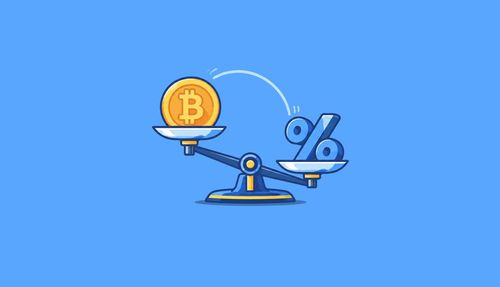
Persistent crypto interest rates force investors to compare opportunities that rarely competed with one another a few years ago. Capital can remain in digital assets, move into government debt, or simply wait on the sidelines while continuing to generate returns. Speculative markets no longer receive fresh liquidity by default.
The effects extend far beyond Bitcoin. Venture funding slows, leverage becomes more expensive, speculative positions shrink, and projects that once attracted capital with little difficulty suddenly compete for a much smaller pool of available funding.
Crypto interest rates make far more sense when viewed alongside broader monetary policy. Central banks don't set crypto prices, but they heavily influence the liquidity conditions under which those prices are formed. As safer assets begin delivering competitive yields, investors become considerably more selective about the risks they're willing to take.
The Opportunity Cost of Capital When Risk-Free Rates Compete with DeFi
For years, decentralized finance attracted capital because traditional markets offered very little in return. Holding cash generated almost nothing, government bonds paid modest yields, and investors searching for income naturally looked toward DeFi.
High interest rates have changed that equation.
A meaningful risk-free rate of return forces every yield strategy to compete much harder for capital. DeFi protocols are no longer measured only against other crypto opportunities. They are also compared with Treasury bills, money market funds, and other instruments that offer predictable income without smart contract risk premium or on-chain execution risk.
That comparison usually changes investor priorities in several ways:
- capital gradually shifts toward lower-risk yield opportunities;
- DeFi yield compression reduces the gap between on-chain and traditional returns;
- capital reallocation becomes increasingly visible across institutional portfolios;
- investors pay closer attention to risk-adjusted yield differentials instead of headline APYs.
Even during periods of monetary tightening, decentralized finance continues attracting capital. The difference lies in how investors evaluate those opportunities. Yield alone no longer drives allocation decisions. On-chain returns increasingly compete with traditional income strategies that offer comparable returns with fewer sources of risk.
Capital Flight from Yield-Bearing Smart Contracts to Government Bonds
For much of the previous cycle, double-digit DeFi yields attracted capital almost automatically. Traditional fixed-income markets offered little competition, making the additional risk easier to justify.
That balance changed as Federal Reserve rate hikes pushed government bond yields steadily higher. Investors no longer compared one DeFi protocol with another. The comparison increasingly shifted toward Treasury bills and other low-risk instruments capable of generating attractive returns without exposure to smart contract exploits, protocol failures, or on-chain volatility.
Crypto income strategies suddenly had a much higher benchmark to beat. Interest on crypto fixed deposits, lending protocols, and other yield products were expected to deliver more than just attractive returns. Investors increasingly weighed those returns against additional volatility, smart contract risk premium, and the possibility of losing capital through technical or market failures.
Investors became far less willing to accept additional risk for only a modest increase in yield. The gap between traditional fixed income and DeFi had to be large enough to justify moving capital on-chain.
Monetary Policy Transmission Lines into Stablecoin Supply Dynamics
Stablecoin supply often says as much about market conditions as price itself. Periods of expansion usually accompany stronger trading activity and fresh capital entering the crypto ecosystem. Extended phases of quantitative tightening have frequently produced the opposite pattern, with liquidity becoming noticeably more limited.
Higher interest rates play an important role in that process. As Federal Reserve rate hikes tighten financial conditions, more capital remains in traditional financial markets where lower-risk assets offer increasingly competitive returns. That environment has repeatedly coincided with stablecoin market cap contractions and a broader macro liquidity drain across digital assets.
Stablecoins sit at the center of the crypto economy. They are used to buy assets, provide liquidity, settle trades, and move capital between platforms. As their supply expands or contracts, the effects gradually spread across the broader market, influencing everything from trading activity to overall liquidity conditions.
For that reason, changes in stablecoin supply often attract attention long before they appear in price action. A growing supply generally reflects fresh capital entering the ecosystem, while prolonged contractions may indicate that liquidity is becoming increasingly selective as investors reassess where new money is best deployed.
How Higher Borrowing Costs Compress Leverage on Derivatives Platforms
Leverage feels inexpensive when money is abundant. Extended periods of low interest rates encouraged larger positions, cheaper borrowing, and a greater willingness to speculate across perpetual futures and other derivatives markets.
Higher rates gradually reverse those conditions.
As the cost of leverage increases, traders become more selective about the positions they open and the amount of capital they're willing to borrow. Financing speculative trades becomes less attractive, particularly when traditional markets already offer competitive returns with substantially lower risk.
The impact is usually visible across several parts of the derivatives market:
- rising margin borrowing rates increase the cost of leveraged positions;
- lower open interest liquidation activity follows as excessive leverage leaves the market;
- derivative funding rates normalize after prolonged periods of speculative positioning;
- reduced leverage limits the amount of capital flowing into high-beta assets.
Lower leverage doesn't necessarily weaken the market. In many cases, it removes positions that depended more on cheap financing than genuine investor conviction. As monetary conditions tighten, price discovery increasingly reflects available liquidity rather than borrowed capital.
Liquidity Drainage Across Speculative Asset Tiers
Not every part of the crypto market reacts to tighter monetary conditions in the same way. Capital usually becomes more selective before it becomes scarce, and that distinction is often reflected in how different categories of assets perform.
Large cryptocurrencies tend to retain attention longer because they offer deeper liquidity and broader institutional participation. Smaller projects face a different environment. New funding slows, trading activity becomes less consistent, and speculative inflows that previously supported rapid price appreciation begin fading.
The rotation usually becomes obvious only in hindsight. Capital doesn't disappear from the market altogether; it concentrates around a much smaller group of assets. Projects with deeper liquidity, stronger adoption, and established ecosystems continue attracting attention, while weaker narratives struggle to generate the same level of investor interest.
Speculation remains part of every market cycle. High interest rates change where that speculation is directed, making fresh capital considerably harder to attract for projects that lack strong fundamentals or sustained market demand.
Valuation Compression Models for High-Beta Layer-1 Altcoins
High-beta layer-1 projects rarely lose value because their technology suddenly becomes weaker. Valuations often compress because the market begins assigning less value to future growth when capital becomes more expensive.
Traditional finance describes a similar effect through discounted cash flow models. Crypto doesn't rely on those calculations directly, although investor behavior often follows the same logic. The longer a project's investment thesis depends on future adoption, the more sensitive its valuation becomes to tighter financial conditions.
Several factors usually accelerate that repricing:
- higher discount rates reduce the value investors assign to long-term growth expectations;
- high-beta assets experience larger price swings as speculative capital leaves the market first;
- slower ecosystem funding limits the pace of expansion for new applications and infrastructure;
- lower market liquidity makes valuation adjustments sharper once selling pressure increases.
Projects with active users, growing transaction volumes, and sustainable network activity generally adapt more easily to this environment. Markets become less willing to pay for future potential alone, placing greater emphasis on adoption that can already be measured today.
Rebalancing Allocation Strategies During Prolonged Monetary Tightening
High interest rates don't require abandoning crypto altogether. They require approaching portfolio construction differently than during periods of abundant liquidity.
As monetary tightening continues, investors often place greater emphasis on managing risk alongside return. Portfolio decisions become less about chasing the highest-performing asset and more about deciding where capital has the strongest probability of being rewarded over time.
A rebalanced portfolio often reflects that shift through several practical adjustments:
- larger allocations to highly liquid assets — Bitcoin and other established cryptocurrencies generally retain deeper liquidity during periods of market uncertainty.
- greater attention to capital preservation strategies — preserving capital becomes increasingly important when risk-free alternatives generate competitive returns.
- reduced dependence on borrowed capital — lower leverage limits the impact of rising financing costs and unexpected market volatility.
- careful evaluation of staking and yield opportunities — the best interest rates for crypto staking become more meaningful when assessed alongside traditional fixed-income returns rather than in isolation.
- ongoing portfolio reviews — prolonged changes in monetary policy often reshape market leadership, making periodic capital reallocation a normal part of portfolio management.
No allocation strategy performs best under every market condition. Interest-rate cycles continue changing liquidity, investor behavior, and risk appetite long before those effects become fully visible in prices.
Understanding crypto interest rates therefore extends beyond predicting the next decision by the Federal Reserve. It means recognizing how monetary policy gradually influences capital flows across the entire financial system. Investors who adapt to those changing conditions are often better positioned than those relying on strategies developed for a completely different liquidity environment.
FAQ
Why does Bitcoin drop when the Fed raises interest rates?
Higher interest rates reduce overall market liquidity and increase the appeal of lower-risk investments, often leading to weaker demand for speculative assets.
Is it better to hold stablecoins or US Treasuries right now?
That depends on an investor's objectives, risk tolerance, liquidity needs, and expectations for future interest rates.
Do crypto interest rates go up when inflation is high?
Not necessarily. Crypto interest rates are influenced by market demand, available liquidity, and borrowing activity rather than inflation alone.
Why are DeFi lending yields lower than traditional bank rates sometimes?
Higher government bond yields and tighter monetary policy can reduce borrowing demand, putting downward pressure on DeFi lending returns.
How do high interest rates affect crypto staking rewards?
Staking rewards usually don't change because of central bank decisions, although they may become less attractive compared with higher traditional fixed-income yields.
What happens to altcoins when interest rates finally cut?
Many investors ask, are interest rate cuts good for crypto? Lower interest rates often improve market liquidity and increase investor appetite for risk, although they don't guarantee an immediate recovery across the crypto market.